
Improvising the Future
What an interdisciplinary performance revealed about connection, uncertainty, and the practice of staying together

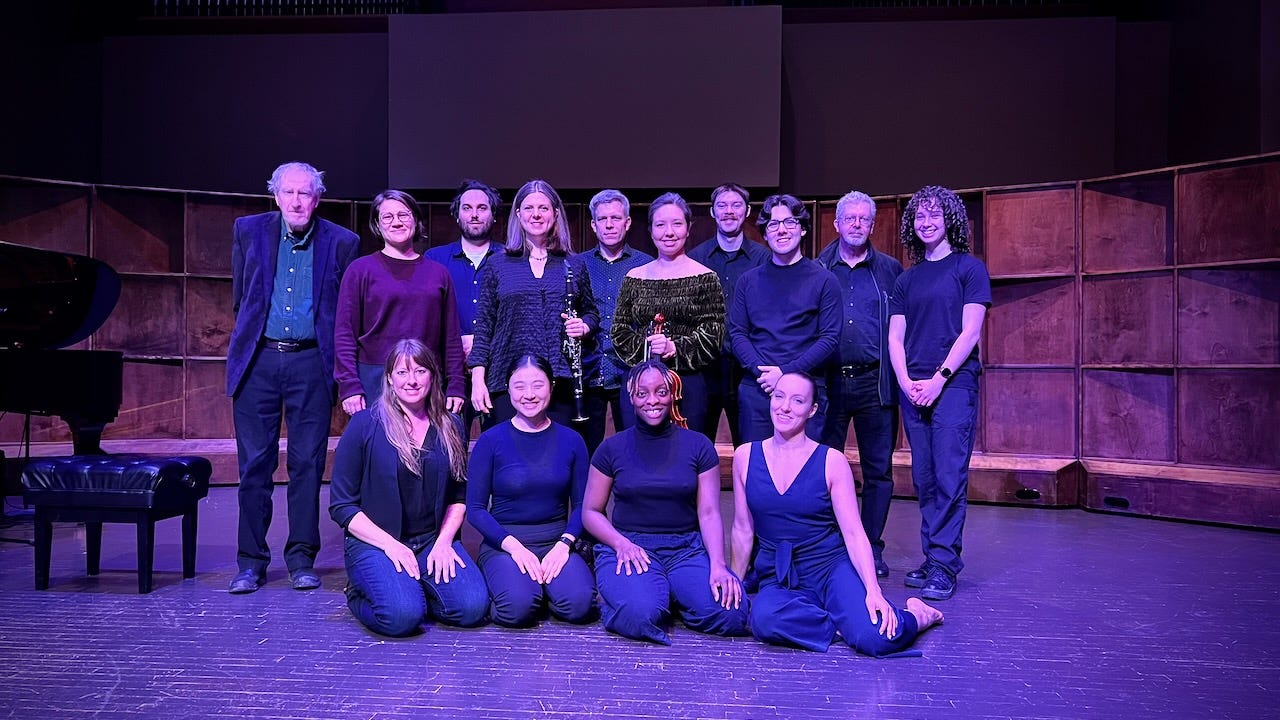
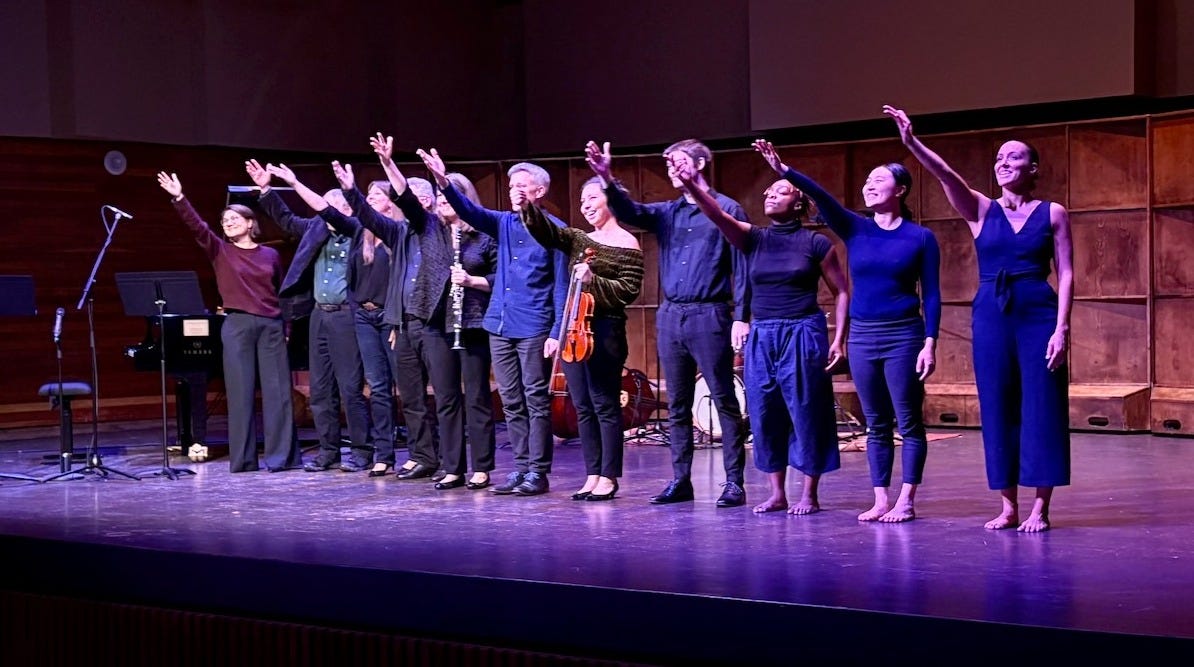
Earlier this year, I choreographed and directed Rhythm in Blue, an interdisciplinary concert created in collaboration with internationally acclaimed clarinetist Christine Carter, whose creative vision anchored the musical core of the project. The production brought together a large ensemble of artists, led by a partnership between Looking Glass Ensemble and Iris Trio.
Presented by Music at Memorial in St. John’s, NL, the concert wove together words, music and movement across contemporary, classical and jazz forms and featured the work of 15 artists - poets, musicians, composers, dancers and a choreographer.
What I didn’t anticipate was how much this artistic process began to feel like a rehearsal for how we might hold onto our differences without falling apart.
Rehearsing Connection Across Difference
The whole endeavour was the result of many layers of collaboration. Over the course of a weeklong residency at MUN’s D.F. Cook Recital Hall, the artists and creative team worked to become one cohesive ensemble — embracing our differences and unique talents as the assets that they are.
There were different needs and considerations for each discipline, including different priorities about how to allocate time. There were also different individual needs among the multi-generational cast — performers in their 20s, 30s, 40s, 60s, and 80s. However, what we shared was a deep curiosity about what becomes possible when we allow ourselves to play outside the conventions of our respective art forms. We worked hard and felt a lot of feelings along the way.
The program rested on a few guiding values: that agency among disciplines would be shared, and that a variety of aesthetic preferences and traditions could be present without collapsing into a singular creative signature. Nonetheless, the show had to hold together. And it was my role, as director, to support that goal.
The structure of the evening mirrored the very questions we were asking.
Structure as a Container
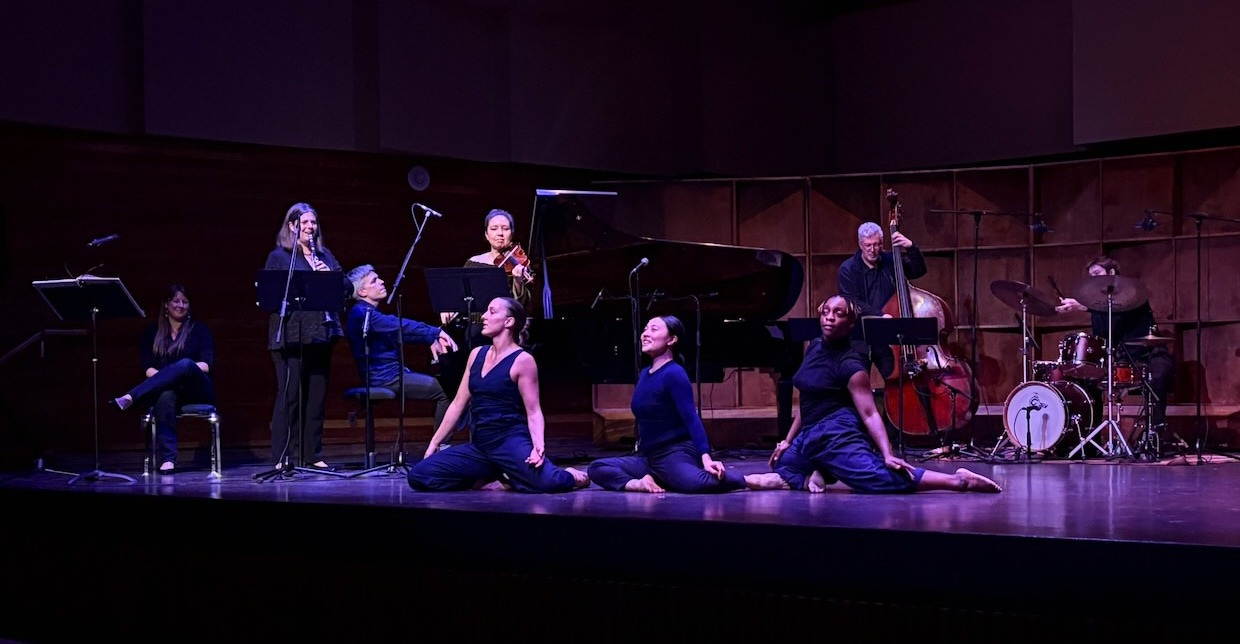
The first half featured poetry by Don McKay and Karen Solie, alongside classical works composed by Florian Hoefner, Kinan Azmeh, Sarah Sleen, and David Braid, performed by Christine Carter, Zoë Martin-Doike, Madeline Hildebrand, and Florian Hoefner. It also included choreographed contemporary dance that I co-created with dancers Nickeshia Garrick, Judy Luo, and Kathia Wittenborn, each bringing a variety of training histories and movement aesthetics into the process.In this part of the program, our aim was to see what was possible through the nuanced weaving of forms in a highly structured and timed way.
We paid close attention to pacing, transitions, and spatial relationships. How long does a line of poetry need before a musical phrase can enter? Where does the audience’s eye land when two forms are active at once? How does the audience encounter the individual elements and the whole?
We played with ways to focus the audience’s attention across disciplines — guiding it deliberately, allowing each form to support and be supported by the others. The structure was a container, requiring discipline, clarity, and a shared understanding of timing.
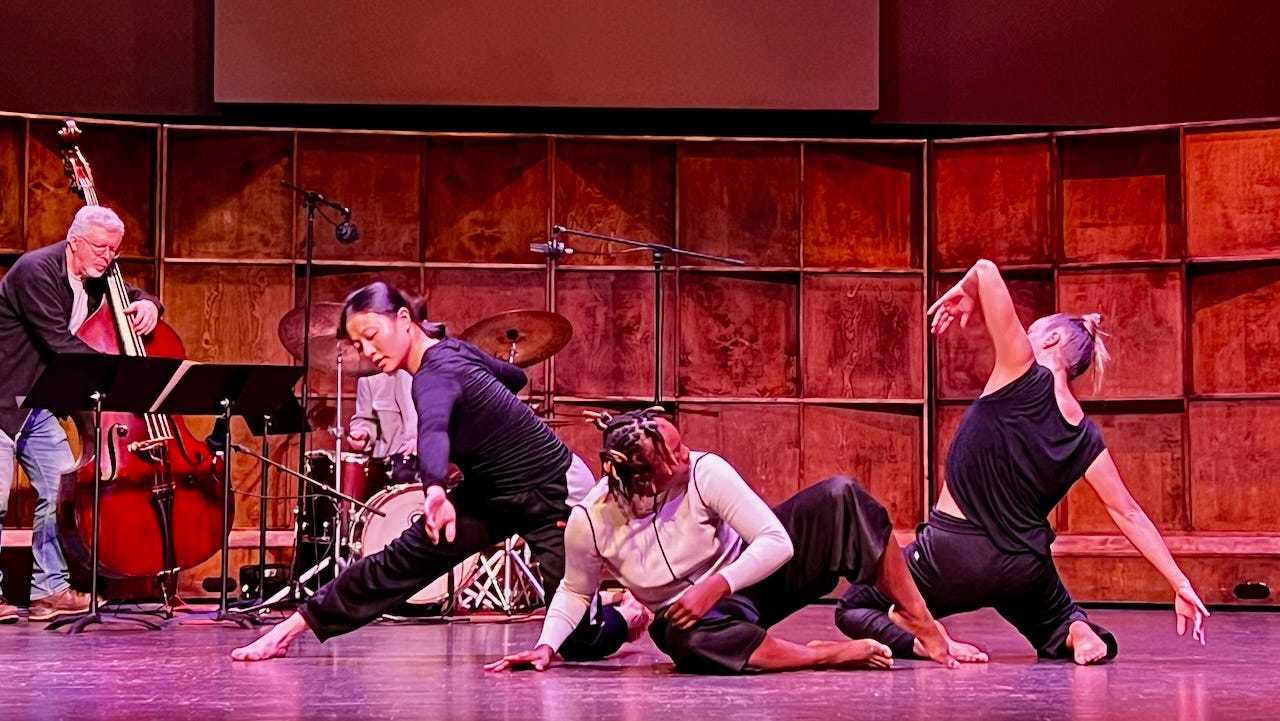
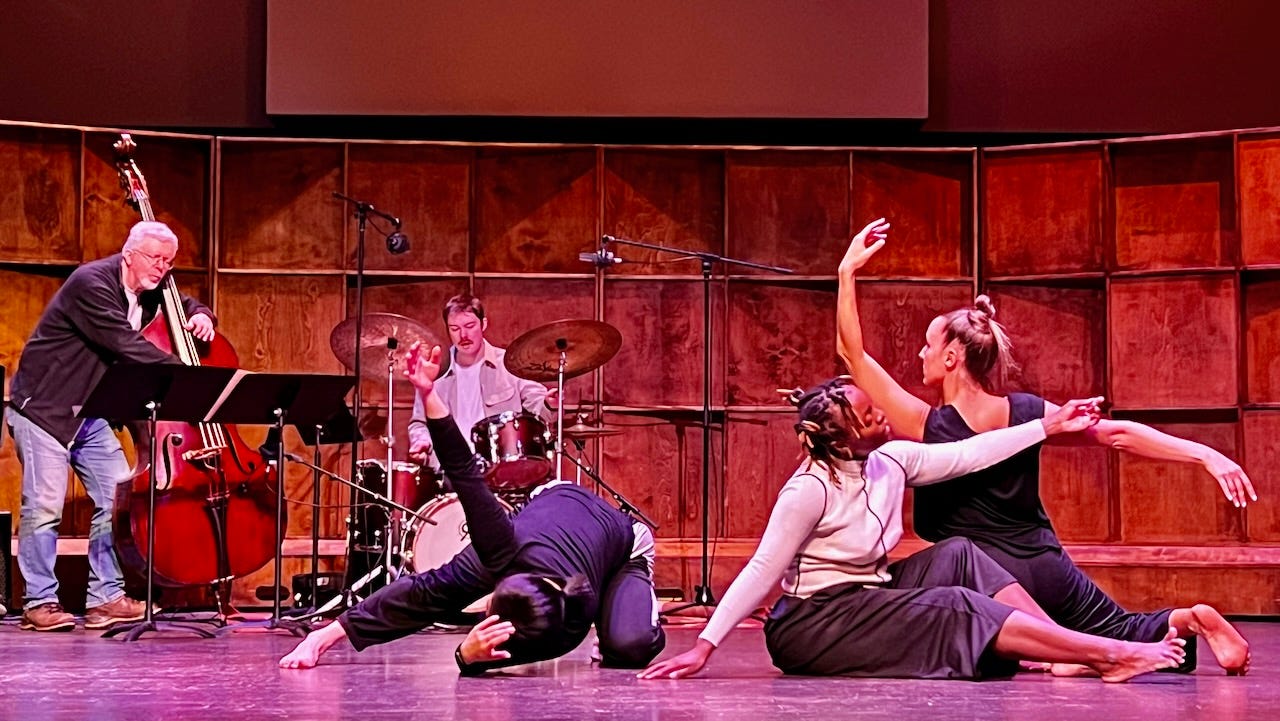
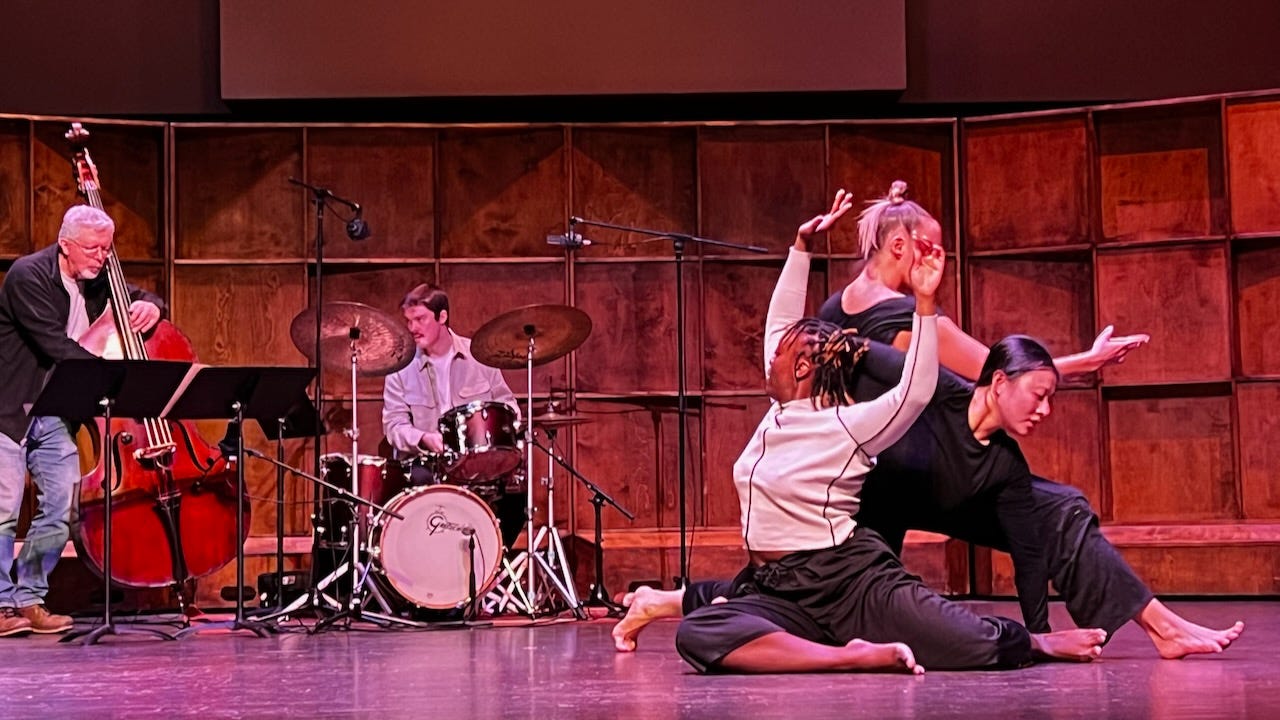
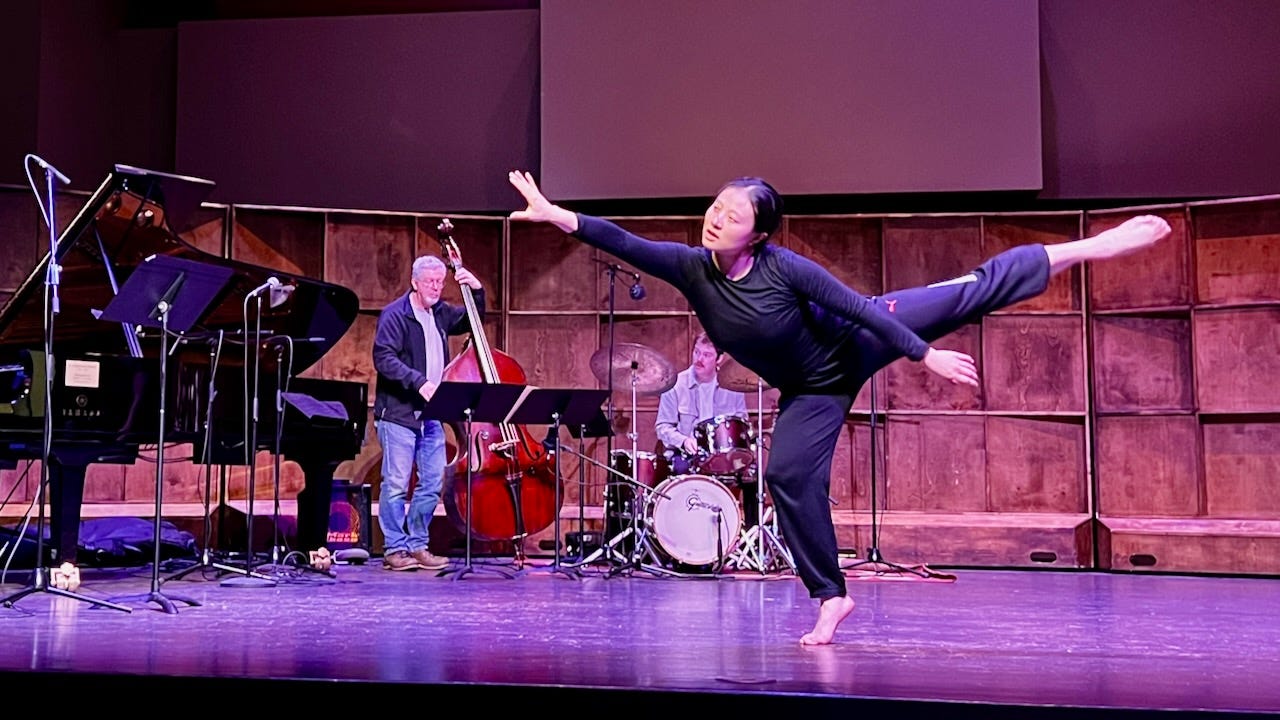
Then, in the second half, we were joined by jazz musicians Jim Vivian on bass and Jacob Slous on drums - shifting the program into a world of improvisation.
Expanding the Container
Now the mood in the hall felt different. A little looser and a little more charged as the artists on stage amplified how they listened and responded to each other. The musicians’ eyes had to lift more often to see the dancers’ responses to the music. The dancers were composing in action - — listening not just with their ears, but with their whole bodies.
We were exploring what becomes possible when we have to sense and respond to a moment. Here we were in new territory — finding our way through a series of “what if” proposals and experiments. What if a musical solo became a music and movement duet? What if a dancer used their voice? How would we recover if we got lost?
In exploring those possibilities, our collective attention sharpened because risk was not theoretical — it had stakes. A missed connection might be visible. And…a successful leap into the unknown might ripple profoundly through the room.
This is what I think is the sweet spot: The place where something could almost fall apart — but where we are still able to hold it together.
As we experimented together, musicians expanded their boundaries by inviting dancers into their improvisational structures. Instrumental solos became duets with a dancer. Listening now involved looking — seeing rhythm play out through bodies in space.
For the dancers, groove — not just choreography — became the foundation. A map of time and space created a structure for movement invention. Improvising to jazz music was new-ish territory for me as well. I had to learn the rules and structures that guide musicians and translate those into physical maps the dancers could inhabit and play within.
At a certain point, what I felt was holding it all together was connection. As long as the group — dancers and musicians — stayed connected, it would be fine. As an audience, we felt that connection too, because the bond of the group invited us in - strengthening the energetic tether between the action on stage and the bodies witnessing it.
Some of the lessons I gleaned from the experience were these:
Curiosity is a powerful starting point.
Asking questions expands what you have to work with.
There is a knowing from the inside that often needs to be made visible and named.
Play and experimentation lead to unexpected discoveries.
The audience is part of the cast. We are all connected.
There is room to consider diverse needs within a whole.
When things are not clear, pause and return later — maybe after a good night’s sleep.
Joy can be fuel for creativity.
Fun and play can also fuel for creativity.
Let the process be the purpose.
What began as an artistic process started transforming into a study of something much larger — how people stay connected when the structures around them begin to loosen.
These questions, and these lessons, feel especially potent given the times we are living through.
From Art Making to World Building
A world designed for control and predictability is revealing its fragility. Systems built on efficiency and optimization are beginning to strain under the weight of instability. Life feels uncertain. Many of us feel less connected to each other. The promise that planning alone could secure the future is eroding.
And yet, as poet Karen Solie reminds us, “we are capable of terrible things when we feel alone.”
Isolation is not just an emotional state. It is a social condition. When connection frays, fear moves in to fill the gap. When we lose the ability to sense and respond to one another, we default to rigidity, polarization, and withdrawal.
So what would it mean to practice not being alone?
Exploring the spectrum between composition and improvisation is akin to exploring the spectrum between predictability and unpredictability — what is known and what is unknown — and the different capacities required inside each condition.
Composition asks for discipline, clarity, shared timing, structure. Improvisation asks for listening, responsiveness, risk, and trust.
We need both.
Looking forward from inside this instability, we need new capacities (or perhaps very old ones), remembered. We need the capacity for connection to hold us together — to ride that edge of, I am still within my skillset, but I need to take risks in order to move forward. We need to improvise. We need to sense what is happening and respond to the best of our ability, because our best laid plans are difficult to execute when the environment shifts faster than our systems can adapt.
The question is no longer whether uncertainty will define our era. It already does.
The question is whether we can stay connected while we move through it.
Practicing Joy
That week of creating together was a gift. It felt almost radical to experience that much joy while simultaneously living in a world that is full of so much turmoil. There was always a kind of alertness in the room - an aliveness that came from not knowing exactly what would happen next, and trusting that we would find our way together.
We were revelling in our love of artmaking, creativity and interdisciplinary performance. And we were remembering that even in hard times, we can experience beauty, joy and a profound sense of our aliveness.
There is something quietly radical about that.
In a moment where there is so much loss and grief and struggle and harm, feeling joy — and feeling joy together — is not trivial. It is not escapism. It is a refusal to collapse. The sheer permission we give ourselves to feel joy matters.
Because the truth beneath Solie’s words remains — that isolation can deform us, and that connection is not sentimental, but protective.
Art is here to interrupt that aloneness. Art is here to create connection — to joy and to beauty, yes — but also to the full range of human feeling, and to the collective solidarities that emerge when we allow ourselves to feel together. It helps us practice staying together through the unknown. It gives us a way to sense and respond rather than retreat or harden.
A Rehearsal for the Future
In that sense, Rhythm in Blue was not just a performance. It was a rehearsal.
A rehearsal for how we might hold difference without collapse.
A rehearsal for improvising together inside instability.
A rehearsal for remembering that connection — and joy — are what make it possible for us to remain human with one another.
dance practice as life practice. so great reading your POV shannon. and yes rehearsal stills! xx
I spend a lot of my time thinking about the institution's relationship to the ideas you outline. I'm reminded of the seminal work of the late Richard Evans at EmcArts, who alongside his incredible team, describes the emerging behaviours and mindsets institutions need in the face of rapidly changing environments: 1) a mission that focuses on community/field impacts and public value rather than outputs and achievements; 2) diversified program curation that includes dialogue with external voices rather than a singular program vision and direction; 3) creative assets that are structured to reach across multiple sectors rather than maximize value exclusively within the cultural sector; 4) loose organizational boundaries that emphasize shared civic engagement rather than strong boundaries serving organizational differentiation; 5) structures of distributed adaptive leadership and agile cross-functional teams rather than heroic leaders and formal hierarchies; 6) engagement of diverse networks of active participants rather than marketing to passive consumers; 7) continuous waves of action learning (experimentation, prototyping, and scaling of divergent approaches) rather than multi-year strategic planning and continuous improvement of existing strategies; 8) smaller boards structured as champions of change who enroll others rather than large boards structured as core funders and; 9) financial profile that emphasizes working capital and reserves rather than balance sheets that build long-term permanent assets. I see the parallels with the experience you describe show up in some of these elements like this: 1) your emphasis on the creative process 2) your curatorial choice to invite diversity of age and practice 5) your role as lead collaborator who holds on tightly but lets go loosely and 7) improvisation as both form and content. I also deeply appreciate your emphasis on joy.